Heart rhythm problems do not always occur continuously. A person may have normal heart rhythm during a routine ECG but experience palpitations, an irregular heartbeat, dizziness, or fainting at another time. In such situations, a Holter test can provide valuable information by continuously recording the heart’s electrical activity during normal daily life.
For patients looking for a Holter test in Rajahmundry, Holter monitoring is a useful non-invasive investigation for detecting intermittent heart-rhythm abnormalities and correlating symptoms with changes in heart rhythm.
What Is a Holter Test?
A Holter test, also called Holter monitoring or ambulatory ECG monitoring, is a portable test that continuously records the electrical activity of the heart for an extended period.
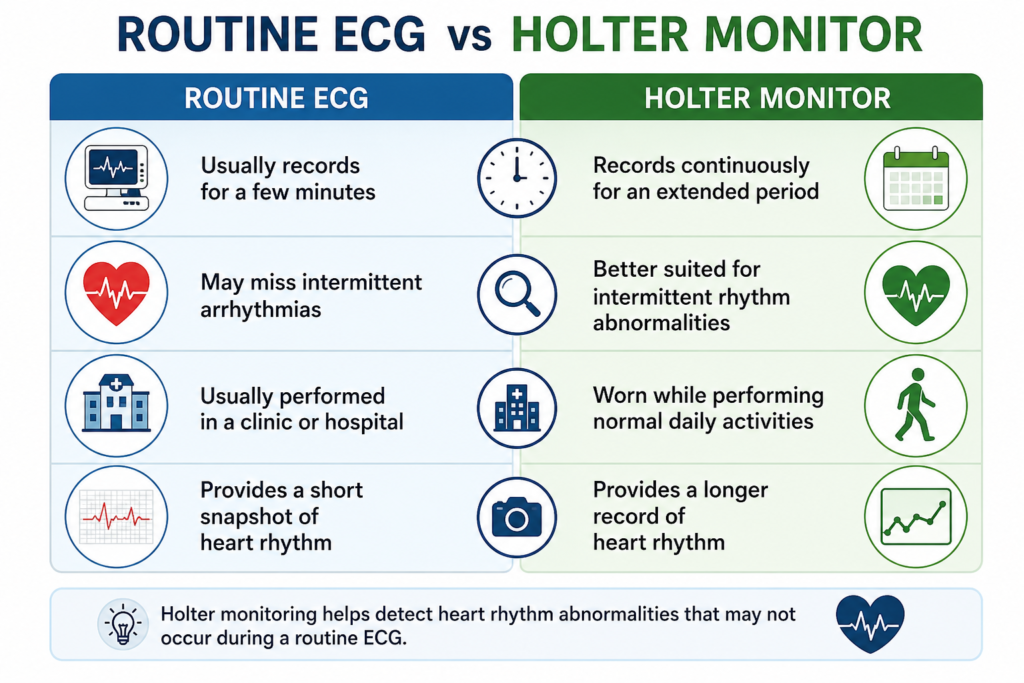
Unlike a routine ECG, which generally records the heart rhythm for only a few minutes, a Holter monitor records the heart continuously while the patient goes about normal daily activities.
Depending on the clinical requirement, monitoring may be performed for:
- 24 hours
- 48 hours
- Several days or longer with extended ambulatory monitoring
ECG vs Holter Monitoring
A routine ECG can identify abnormalities that are present at the time of the test. However, intermittent rhythm problems may not occur during those few minutes.
A Holter monitor provides a longer period of recording, increasing the likelihood of detecting an abnormal rhythm when symptoms occur.
Why Is a Holter Test Done?
A cardiologist may recommend Holter monitoring when a patient’s symptoms could be related to an abnormal heart rhythm.
Common reasons include:
- Palpitations or a sensation of the heart racing, pounding, fluttering, or skipping beats
- Fast heartbeat
- Slow heartbeat
- Irregular heartbeat
- Dizziness or light-headedness
- Fainting or near-fainting
- Unexplained weakness
- Suspected arrhythmia
- Evaluation of known rhythm disorders
- Monitoring the response to treatment for certain arrhythmias
Holter monitoring can also help determine whether a patient’s symptoms occur at the same time as an abnormal heart rhythm.
What Heart Problems Can a Holter Monitor Detect?
Holter monitoring can detect many types of abnormal heart rhythms, particularly those that occur intermittently.
Atrial Fibrillation (AF)
Atrial fibrillation is an irregular heart rhythm originating in the upper chambers of the heart. It may occur continuously or intermittently. Holter monitoring can help identify episodes of AF and document their duration and frequency.
Atrial Flutter
Atrial flutter is another abnormal rhythm arising from the atria. Depending on how frequently it occurs, a Holter monitor may help detect and characterize episodes.
Supraventricular Tachycardia (SVT)
SVT refers to episodes of abnormally rapid heart rhythm originating above the ventricles. Because episodes can begin and stop suddenly, a routine ECG may not capture them. Longer monitoring can increase the chance of documenting an episode.
Premature Atrial Contractions (PACs)
PACs are early heartbeats originating from the atria. Occasional PACs are common, but frequent or symptomatic PACs may require further evaluation.
Premature Ventricular Contractions (PVCs)
PVCs are premature beats originating from the ventricles. A Holter report can quantify the number and frequency of PVCs and identify patterns such as repetitive or complex ventricular ectopy.
Ventricular Tachycardia (VT)
Holter monitoring may detect episodes of ventricular tachycardia. Depending on the patient’s symptoms and clinical condition, detection of significant ventricular arrhythmia may require urgent cardiology evaluation.
Bradycardia
Bradycardia means an abnormally slow heart rate. Holter monitoring can determine how frequently slow heart rates occur and whether they are associated with symptoms.
Tachycardia
Tachycardia refers to an abnormally fast heart rate. Holter monitoring can identify episodes, their duration, and the associated rhythm.
Sinus Pauses
A Holter monitor can identify pauses in the heart’s rhythm and help determine their duration and clinical significance.
Heart Block
Holter monitoring can sometimes detect conduction abnormalities such as different degrees of heart block, particularly when these occur intermittently.
Other Intermittent Arrhythmias
Holter monitoring may also identify other rhythm abnormalities that are not present during a short routine ECG.
How Is a Holter Test Performed?
Holter monitoring is a simple, non-invasive procedure.
The usual process involves:
- Small adhesive electrodes are placed on the patient’s chest.
- The electrodes are connected to a portable recording device.
- The monitor is attached to clothing, worn around the waist, or carried according to the device design.
- The monitor continuously records the heart’s electrical activity.
- The patient generally continues normal daily activities as advised by the healthcare team.
- After the prescribed monitoring period, the device is returned for analysis.
- The recorded ECG data is reviewed and interpreted by the cardiology team.
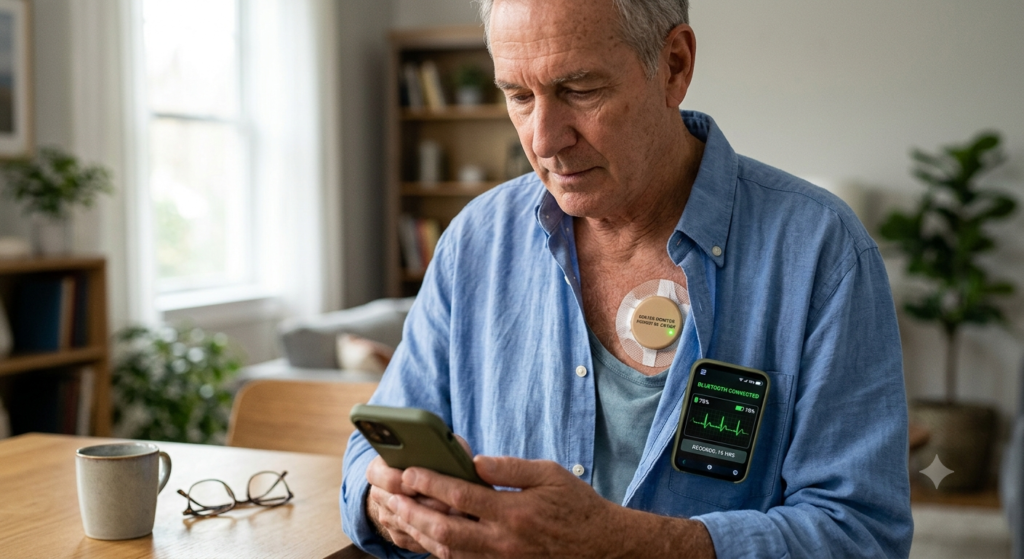
Patients may also be asked to maintain a symptom diary, noting the time of palpitations, dizziness, chest discomfort, fainting, or other symptoms.
How Long Do You Need to Wear a Holter Monitor?
The monitoring period depends on how frequently symptoms occur and what the cardiologist is trying to evaluate.
24-Hour Holter
A 24-hour Holter is commonly used when symptoms occur frequently or when continuous rhythm assessment is required.
48-Hour Holter
A 48-hour recording provides a longer observation period and may be useful when symptoms do not occur every day.
Extended Ambulatory Monitoring
If symptoms are infrequent, a longer period of ambulatory ECG monitoring may be considered. The appropriate monitoring duration is determined by the cardiologist.
In general, the less frequently symptoms occur, the longer the monitoring period may need to be to capture the abnormal rhythm.
What Should You Do While Wearing a Holter Monitor?
Unless specifically instructed otherwise, patients can usually continue their normal routine.
During monitoring:
- Continue your usual activities as advised.
- Take prescribed medicines according to your doctor’s instructions.
- Maintain a symptom diary.
- Record the exact or approximate time when symptoms occur.
- Note palpitations, dizziness, fainting, chest discomfort, breathlessness, or unusual sensations.
- Press the event button if your device has one and you experience symptoms.
- Follow the hospital’s instructions regarding exercise, bathing, and device care.
Recording the timing of symptoms is important because it allows the cardiologist to compare your symptoms with the ECG recording.
What Should You Avoid During Holter Monitoring?
The instructions depend on the type of Holter device being used.
Generally:
- Avoid getting the monitor wet if the device is not waterproof.
- Do not remove electrodes unnecessarily.
- Do not disconnect or tamper with the recording device.
- Avoid activities specifically restricted by your healthcare team.
- Follow the instructions provided by the hospital regarding bathing and exercise.
If an electrode becomes loose, follow the instructions provided by the medical team rather than repeatedly repositioning the equipment without guidance.
Is a Holter Test Painful or Safe?
A Holter test is non-invasive and generally painless. No needles or injections are required for the monitoring itself.
Some patients may experience mild skin irritation, redness, or itching from the adhesive electrodes. This usually settles after the electrodes are removed.
What Happens After the Holter Test?
After the monitoring period:
- The Holter device and electrodes are removed.
- The recorded ECG data is downloaded and analyzed.
- The cardiologist reviews the rhythm recordings and important events.
- Symptoms recorded in the diary are compared with the ECG findings.
- Further investigations or treatment may be recommended if an abnormality is identified.
Treatment depends entirely on the underlying diagnosis. Some rhythm abnormalities may only require observation, while others may require medication, further electrophysiological evaluation, or another appropriate treatment.
Holter Test Cost in Rajahmundry
The cost of a Holter test in Rajahmundry at Godavari Hospital depends on the duration of monitoring:
- 1-day (24-hour) Holter test: ₹5,000
- 2-day Holter monitoring: ₹10,000
- 3-day Holter monitoring: ₹10,000
The appropriate monitoring duration depends on the patient’s symptoms and the cardiologist’s clinical assessment. Longer monitoring may be recommended when symptoms occur less frequently and need to be captured during the recording period.
For the latest information regarding Holter test availability, appointments, and reporting, patients can contact Godavari Hospital directly.
Where Can You Get a Holter Test in Rajahmundry?
Patients looking for a Holter test in Rajahmundry can get Holter monitoring at Godavari Hospital under the care of Dr. Malleswara Rao Dangeti, MD, DM (Cardiology).
The cardiology team provides evaluation and Holter monitoring for patients with symptoms such as palpitations, dizziness, fainting, irregular heartbeat, and suspected heart-rhythm abnormalities.
Godavari Hospital – Holter Monitoring
Hospital: Godavari Hospital
Consultant Cardiologist: Dr. Malleswara Rao Dangeti, MD, DM (Cardiology)
Holter Test: 24-hour, 48-hour and 72-hour monitoring options
1-Day Holter: ₹5,000
2-Day / 3-Day Holter: ₹10,000
Contact / Appointments: 7799777536
Patients can contact the hospital to confirm availability, schedule the test, and obtain information about the reporting and follow-up process.
Frequently Asked Questions About Holter Tests
Is a Holter test painful?
No. Holter monitoring is non-invasive and generally painless. Mild skin irritation from adhesive electrodes can occasionally occur.
Can I sleep while wearing a Holter monitor?
Yes. Patients generally wear the monitor while sleeping. Follow the instructions provided for positioning and protecting the device.
Can I go to work while wearing a Holter monitor?
In most cases, patients can continue their usual daily activities, including work, unless the doctor advises otherwise.
Can I exercise while wearing a Holter monitor?
This depends on your medical condition and the type of monitor. Some patients can continue their usual physical activity, while others may be advised to avoid strenuous exercise. Follow your cardiologist’s instructions.
Can I shower while wearing a Holter monitor?
It depends on the particular device. Many traditional Holter monitors should not get wet. Always follow the instructions given by the hospital.
Can I travel while wearing a Holter monitor?
Travel may be possible while wearing a Holter monitor, but patients should follow the hospital’s instructions and ensure that the device remains secure throughout the monitoring period.
How long does a Holter test take?
The recording period may be 24 hours, 48 hours, or longer depending on the clinical requirement. Applying the monitor generally takes much less time than the recording period itself.
When will I receive the Holter report?
The reporting time depends on the hospital, recording duration, and analysis required. The hospital can provide the expected reporting time when the device is fitted.
Can a Holter test detect heart blockage?
A Holter monitor primarily evaluates the heart’s electrical rhythm. It is not a test designed to directly diagnose coronary artery blockages.
If coronary artery disease is suspected, your cardiologist may recommend other investigations such as an ECG, echocardiogram, stress testing, CT coronary angiography, or invasive coronary angiography depending on the clinical situation.
Can a Holter test detect a heart attack?
Holter monitoring is not the standard test for diagnosing an acute heart attack. If a patient has symptoms suggestive of a heart attack, immediate medical assessment with an ECG, cardiac biomarkers, and other appropriate investigations is required.
Is Holter monitoring safe?
Yes. Holter monitoring is generally safe and non-invasive. The most common minor problem is skin irritation from the adhesive electrodes.
What if my symptoms don’t occur while wearing the Holter monitor?
If your symptoms do not occur during the monitoring period, the test may not capture the suspected intermittent rhythm abnormality. Depending on the frequency of symptoms, your cardiologist may recommend longer-duration ambulatory monitoring or another appropriate investigation.
Conclusion – Holter Monitoring in Rajahmundry
A Holter test is an important diagnostic tool for detecting intermittent heart-rhythm abnormalities that may not be identified during a short routine ECG. It can help evaluate symptoms such as palpitations, dizziness, fainting, unusually fast or slow heartbeat, and suspected arrhythmias.
For patients seeking a Holter test in Rajahmundry, consultation with a cardiologist can help determine whether Holter monitoring is appropriate and what duration of monitoring is most suitable.
If you experience recurrent palpitations, unexplained dizziness, fainting, or an irregular heartbeat, do not ignore the symptoms. A timely cardiac evaluation can help identify the underlying cause and guide appropriate treatment.