2D Echocardiogram (2D Echo) Test – Purpose, Procedure, and Benefits
A 2D Echocardiogram, commonly known as a 2D Echo, is one of the most essential and widely performed heart imaging tests. It provides a clear view of the heart’s structure and function using harmless ultrasound waves.
At Godavari Hospital, Rajahmundry, our advanced echocardiography system helps cardiologists evaluate your heart’s health with precision, ensuring early diagnosis and timely treatment.
What is a 2D Echocardiogram?
A 2D Echocardiogram is a non-invasive ultrasound test that captures live, moving images of the heart. It allows doctors to visualize the heart’s chambers, valves, walls, and blood flow patterns in real time.
It uses high-frequency sound waves (ultrasound), which bounce off heart structures to create detailed 2-dimensional images on a monitor.
This test provides invaluable insights into how effectively the heart is functioning.
Why is a 2D Echo Test Done?
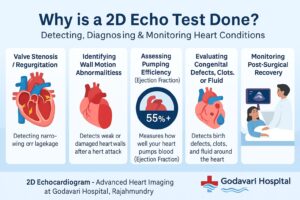
Your cardiologist may recommend a 2D Echo test for several reasons, such as:
-
Detecting heart valve abnormalities like stenosis or regurgitation:
The human heart has four valves — mitral, tricuspid, aortic, and pulmonary — which act like one-way doors. They open and close with every heartbeat to ensure blood flows in the correct direction.
When these valves don’t function properly, the heart has to work harder to pump blood. A 2D Echocardiogram helps visualize these valves in motion and detect two major types of valve problems: 1. Valve Stenosis (Narrowing of the Valve Opening) and Valve Regurgitation (Leakage of Blood Backward) -
Identifying wall motion abnormalities or damage after a heart attack: After a heart attack (myocardial infarction), the affected area may become weak, stiff, or completely non-moving due to reduced blood supply. These abnormalities indicate damaged or scarred heart tissue that cannot pump efficiently. By assessing how each wall segment moves, doctors can pinpoint the exact region of heart damage. This helps in evaluating the extent of heart attack injury and guiding further treatment or recovery planning.
-
Assessing pumping efficiency (Ejection Fraction) to measure how well your heart pumps blood: A 2D Echocardiogram measures the heart’s pumping efficiency through a key parameter called Ejection Fraction (EF). Ejection Fraction represents the percentage of blood pumped out of the left ventricle with each heartbeat. A normal EF is 55% or higher, indicating that the heart is pumping effectively. A low EF suggests weakened heart muscles, often seen in heart failure or after a heart attack. By measuring EF, doctors can evaluate heart strength, monitor treatment progress, and adjust medications accordingly.
-
Evaluating congenital heart defects, clots, or fluid accumulation around the heart :A 2D Echocardiogram is highly useful for detecting congenital heart defects, which are structural abnormalities present from birth—such as holes in the heart (ASD, VSD) or abnormal vessel connections. It can also identify blood clots (thrombi) that may form inside the heart chambers after certain conditions like arrhythmia or heart failure. Additionally, it helps detect fluid accumulation around the heart (pericardial effusion), which can restrict heart movement.
-
Monitoring post-surgical recovery or follow-up after procedures like bypass or valve replacement
When Does Your Doctor Recommend a 2D Echo?
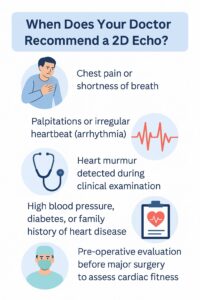
You may need a 2D Echo if you experience:
-
Chest pain or shortness of breath
-
Palpitations or irregular heartbeat (arrhythmia)
-
Heart murmur detected during clinical examination
-
High blood pressure, diabetes, or family history of heart disease
-
Pre-operative evaluation before major surgery to assess cardiac fitness
How is the 2D Echo Test Performed?
Step-by-Step Procedure
-
Preparation: No fasting is required. The test is done in a quiet room.
-
Positioning: You will be asked to lie on an examination couch, usually on your left side.
-
Gel Application: A special gel is applied to your chest to help transmit ultrasound waves.
-
Imaging: The cardiologist moves a small probe (transducer) across your chest to capture images of your heart.
-
Duration: The entire process takes about 15–30 minutes.
Is the Test Painful or Risky?
Not at all. The 2D Echo is completely safe, painless, and radiation-free. It does not involve any injections, contrast dye, or harmful exposure, making it suitable for patients of all ages—including pregnant women.
What Information Does a 2D Echo Provide?
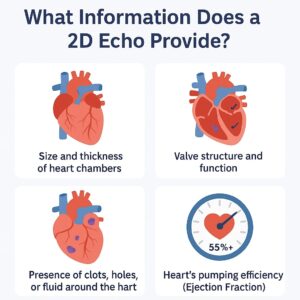
The test gives detailed information such as:
-
Size and thickness of heart chambers: The heart has four chambers — two atria (upper) and two ventricles (lower) — that receive and pump blood.
Their walls are made of cardiac muscle, whose thickness reflects how hard each chamber works. The left ventricle has the thickest wall as it pumps blood to the entire body, while the atria have the thinnest. A 2D Echocardiogram measures these sizes and thicknesses to detect enlargement or weakness of the heart. -
Valve structure and function: The heart has four valves — mitral, tricuspid, aortic, and pulmonary — that control blood flow between its chambers and major vessels. Each valve opens and closes in sync with every heartbeat to ensure blood moves forward and doesn’t leak backward. Their structure and motion can be clearly seen on a 2D Echocardiogram, helping detect stiffness, narrowing, or leakage. This evaluation ensures the valves are functioning properly and maintaining smooth, efficient blood circulation.
-
Presence of clots, holes, or fluid around the heart (pericardial effusion)
-
Heart’s pumping efficiency (Ejection Fraction)
2D Echo vs TMT vs ECG – What’s the Difference?
| Test | Purpose | Type | Key Use |
|---|---|---|---|
| ECG (Electrocardiogram) | Records electrical activity | Non-imaging | Detects rhythm issues, heart attack signs |
| TMT (Treadmill Test) | Measures heart performance under stress | Functional | Evaluates exercise tolerance and ischemia |
| 2D Echo | Shows heart structure and motion | Imaging | Detects structural or functional heart defects |
All three tests often complement each other for a complete cardiac assessment.
How to Prepare for a 2D Echo Test
-
No fasting or special preparation is required.
-
If you are undergoing a Stress Echo, avoid caffeine or heavy meals 2 hours before the test.
-
Wear comfortable, loose-fitting clothing.
-
Inform your doctor about any ongoing medications.
Who Performs the Test?
At Godavari Hospital, Rajahmundry, 2D Echo tests are performed by a team of experienced Cardiologists and trained Echo Technicians under expert supervision.
The department is led by Dr. Malleswara Rao, a renowned Cardiologist known for his diagnostic precision and compassionate care. Every test is reviewed carefully, and results are explained to patients in simple terms.
Why Choose Godavari Hospital for 2D Echo in Rajahmundry
-
Advanced digital echocardiography system for superior image clarity and accuracy
-
Expert cardiologists with years of diagnostic experience
-
Quick reporting and consultation immediately after the test
-
Integrated cardiac care services with Cath Lab, ICU, and Emergency backup
-
Convenient location opposite Kambala Cheruvu Park, Main Gate, Rajahmundry
Your heart deserves the most reliable and advanced care—and that’s what we deliver.
Frequently Asked Questions (FAQs)
1. How long does a 2D Echo take?
Usually about 5–10 minutes. You can resume normal activities immediately afterward.
2. Can pregnant women undergo it?
Yes. The test uses ultrasound, not radiation, so it’s safe during pregnancy.
3. What is a normal ejection fraction?
A normal Ejection Fraction (EF) is 55% or higher, indicating good pumping function.
4. What if my report is abnormal?
Your cardiologist will explain the findings and may suggest further tests or treatment if needed.
Book Your 2D Echo Test Today
Early detection saves lives.
If you’re experiencing chest discomfort, breathlessness, or want a preventive heart check, book your 2D Echocardiogram Test today at Godavari Hospital, Rajahmundry.
📞 Call: 7799777536
🌐 Visit: https://godavarihospital.co.in
📍 Address: Opposite Kambala Cheruvu Park, Main Gate, Rajahmundry